98.5% accuracy by computer model in Vuelta TTT
Friday 19 September 2025 • Blog

The team time trial (TTT) of the Vuelta a España (stage 5) is the computer's best prediction this season. The five teams predicted by the model as the top five contenders for victory finished in the top five. With UAE Team Emirates (1 in prediction, 1 in result) and Team Visma | Lease a Bike (2 in prediction, 2 in result) as the strongest teams, the model scored the maximum number of possible points. The prediction quality was 98.5% of the maximum, further demonstrating that the team time trial is the discipline best predicted by the self-learning algorithm. The model has found a way to assess the time trial qualities of teams and their riders and link this to an accurate prediction.
CyclingOracle predicts the results of all major races for men and women. The model considers the riders' qualities, the race course, and the strength of the field. More details about the AI model can be found in this blog post. While looking ahead and anticipating the next race is what drives WielerOrakel, we also want to consider the quality of the predictions. To what extent does the outcome match the prediction? And are there races that the computer predicts "better"? To assess the quality of the prediction, points are awarded to riders in the prediction and their performance. If a rider from the top 10 of the prediction finishes in the top 20 of the race, the model scores points. The computer receives more points for a higher result. Furthermore, the performance of the predicted winner is more important than that of the number 10 in the prediction. An overview of the points and factors can be found in Table 1.
| Tabel 1: Points for CyclingOracle model accuracy | ||
|---|---|---|
| # prediction | Points for result | Factor in prediction |
| 1 | 15 | x3.0 |
| 2 | 10 | x2.5 |
| 3 | 7 | x2.0 |
| 4 | 5 | x1.5 |
| 5 | 4 | x1.5 |
| 6-10 | 3 | x1.0 |
| 11-15 | 2 | Top10 gets points |
| 16-20 | 1 | Top10 gets points |
The points scored can then be compared to the maximum possible score, resulting in a percentage. What percentage of the best possible prediction does CyclingOracle's model achieve?
One-day races
Nine of the 20 predicted winners in the 2025 one-day races won, the predicted winner finished in the top 3 12 times, and the eventual winner finished in the model's top 3 13 times. Thirty-two of the 60 predicted riders in the top 3 also finished on the podium. The World Time Trial Championships, the Tour of Flanders, Paris-Roubaix, Milan-San Remo, the Scheldeprijs, and the Amstel Gold Race were very well predicted by the AI model (scores of over 80% accuracy). The Classic Brugge-De Panne and Eschborn-Frankfurt were two races that were less accurately predicted (well below 40%).
Looking at the top 10 predictions of 20 men's one-day races, the computer arrives at an average score of 62.9%. The AI model's predictions in these races therefore achieve an average of 62.9 percent of the maximum possible points according to the scoring system. This score varies between 5 and 88 percent per race. The best-predicted race of 2025 was the World Time Trial Championships. The computer predicted Pogacar, Evenepoel, and Vine on the podium, with all three finishing in the top 5. Armirail (predicted 4th, finished 8th), Küng (5 > 10), del Toro (6 > 5), Plapp (7 > 7), Arensman (8 > 9), and Van Wilder (9 > 3) were also in the top 10 of the predictions and earned points for the computer by finishing in the top 20: 9 out of 10 in the top 10.
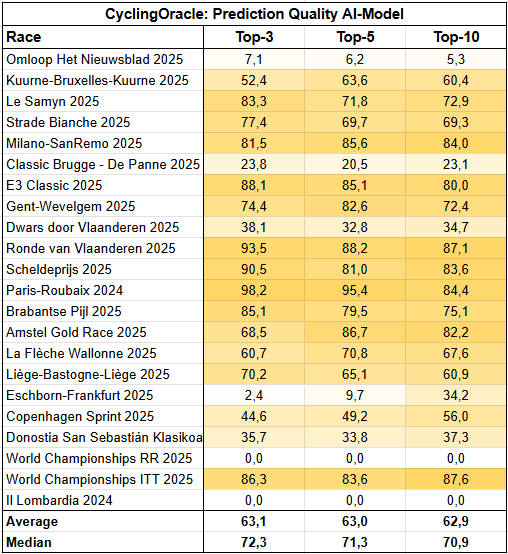
Omloop Het Nieuwsblad was the one-day race that the computer, just like last year, predicted the worst: a score of 5.3 percent of the top 10 predictions. Aert's predicted winner finished 11th, but the rest of the sprinters in the results weren't among the top 10 contenders predicted by the model. The scenario (sprint) turned out to deviate significantly from the expected race course.
GrandTours: Giro, Tour and Vuelta
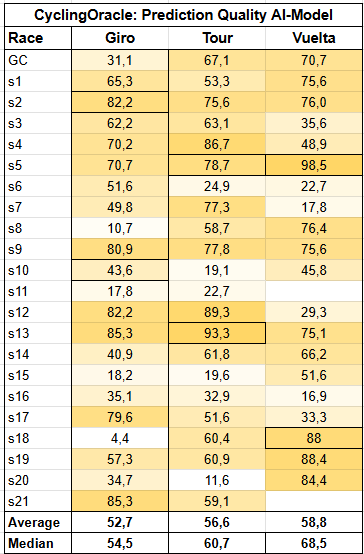
In the 2025 Grand Tours, the computer predicted 61 stages and 3 classifications. Of those 64 predictions, 23 were correct, and the predicted winner won the race. Pedersen (5 stages of the Giro and Vuelta), Vingegaard (3 stages and the Vuelta classification), Pogacar (4 stages and the Tour classification), and Philipsen (4 stages of the Tour and Vuelta) proved to be the most correct predictions; these top riders were often the favorites according to the model. The Vuelta had 10 correct predictions, the Tour was successful 7 times, and we had the opportunity to cheer for the computer 6 times in the Giro.
Besides the Vuelta team time trial (the top 5 predicted teams finished top 5), the individual time trials in the Giro, Tour de France, and Vuelta were also among the best predictions this season. Stage 13 of the Giro (the top 3 also finished in the top 3), Stage 4 (all 10 finished in the top 20), and Stage 12 (1-2 for Pogacar and Vingegaard) of the Tour de France also stood out. Traditionally, the model struggles with stages that result in a battle between the early breakaway riders, while a GC battle (or sprint) was expected (e.g., Stages 6 and 7 of the Vuelta, Stage 10 of the Tour de France, and Stage 18 of the Giro).
The figure below shows the accuracy of the top 10 predictions of all 64 predictions (time trials outlined in black). The average score for the Giro is 52.7% and is higher for the Tour (56.6%) and Vuelta (58.8%). The high median score for the Vuelta (68.5%) demonstrates a high number of accurate predictions, while the less accurate predictions also score very low. Compared to 2024 (an average of 47.5% of the maximum), the Vuelta scored better in 2025 thanks to the presence of two frequent winners (Vingegaard and Philipsen). In the Giro, this dominant rider (Pogacar) was absent compared to 2024, resulting in a slightly lower average score.
2026 here we come!
In 2025, it was confirmed that the computer performs strongly in time trials, sprint stages, and mountain stages where the GC favorites are vying for the win. Predicting the right riders to join and survive the breakaway remains a major challenge, as does predicting a GC position that few riders will continue to fight for (crashes or poor form).
In the coming weeks, we will add two more predictions to the analysis. In 2026, we will again evaluate the AI model's performance by evaluating it using the method described in this blog. Studying the computer's strengths and weaknesses helps us improve the model. If you have any questions or suggestions, we are open to constructive ideas and contributions regarding our model. Let us know via DM on Instagram or email us at [email protected].