Spring classics 2026: accuracy of computer model
Tuesday 28 April 2026 • Stats

Voorjaarsklassiekers 2026: accuratie van het computer model
The 2026 spring classics have come to a close. It is time to look back and evaluate teh predictions of our model. At CyclingOracle, we don’t aim to develop a perfect model. Instead, our goal is much more rewarding: to build excitement together with you, the fans, for those magnificent, unpredictable classics that keep us on the edge of our seats. We aim to grasp the beauty of the sport and its unpredictability. Still, as data enthusiasts, we are curious: how close did we get to the heart of the action this spring?
The strength of the field
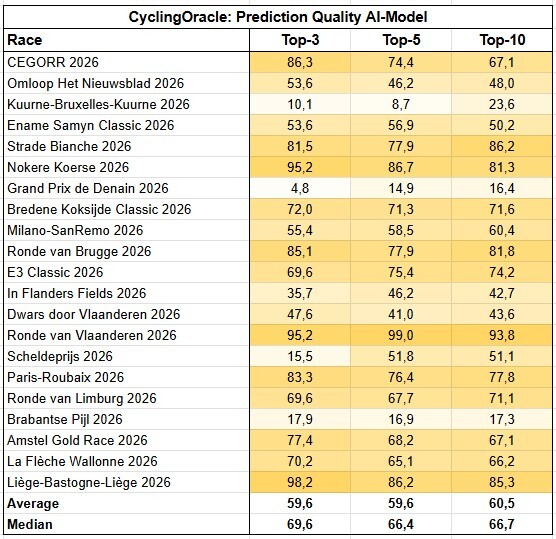
For every race, we model the ten riders who we believe have the highest chance of victory. We then measure the quality of that selection by how often they finish in the top 20 of the final results. This accuracy score serves as our benchmark. With an average of 60.5% and a median score of 66.7%, we can conclude that we consistently identified the right contenders.
Our model proved particularly sharp in the iconic monuments and the most selective classics. Take the Tour of Flanders: with 93.8% of our top 10 prediction and an almost flawless 99.0% in the top 5, we were right in the thick of the race. Seeing Tadej Pogačar, Mathieu van der Poel, and Remco Evenepoel color the race was no surprise, it was the validation of the race dynamics we had all been looking forward to. Similarly, in Liège-Bastogne-Liège, we successfully pinpointed the key men for the finale with 85.3% accuracy of the top-10 of the model.
Cycling is unpredictable, and that is a good thing
Of course, there are races where we missed the mark. In Kuurne-Brussel-Kuurne (23.6%), the Grand Prix de Denain (16.4%), and the Brabantse Pijl (17.3%), we found ourselves playing catch-up. But to be fair, that unpredictability is the very charm of the sport. If every model predicted every race perfectly, the excitement would vanish from cycling in an instant.
We saw this in the Cadel Evans Great Ocean Road Race (CEGORR), where Tobias Lund Andresen claimed victory in a sprint that defied conventional logic. Likewise, Paris-Roubaix (77.8%) and the Amstel Gold Race (67.1%) showed that while a model serves as an excellent compass, it is ultimately the legs of a rider like Wout van Aert or a tactical masterstroke by Remco Evenepoel that define the outcome.
Why we do this
Is our model perfect? Absolutely not. But that was never the goal. We build these models because we love the sport. We want to ignite the discussion: who has the best odds? Who will reach the summit first? For us, these numbers are simply a way to enjoy the world of cycling even more intensely.
Whether it’s the cobblestones of the E3 Classic (74.2% top 10) or the heroics of Strade Bianche (86.2% top 10), we are proud to watch these races alongside you. The numbers are in, and the 2026 classics are now part of history. Onward to the next series, where unpredictability remains the only true winner.