


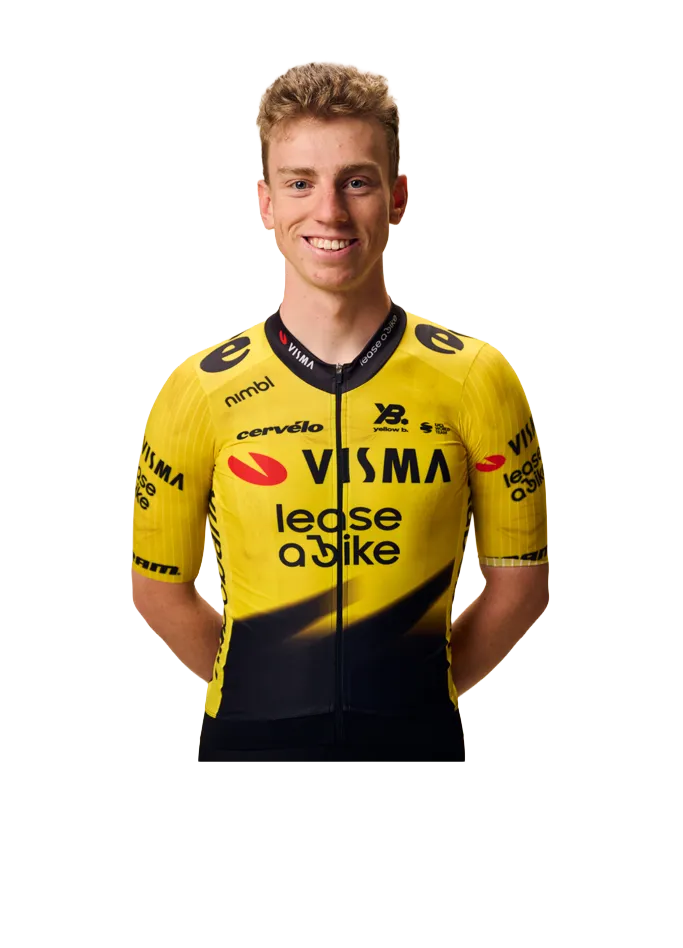







Matthew Brennan
Matthew Brennan is a professional bike-rider from Great Britain. Matthew Brennan is contracted at Team Visma | Lease a Bike and was born on August 6 2005. Matthew Brennan weighs 68 kg and is 177 cm long. More info on Matthew Brennan will be avaialbe soon. Please take look at the skills of Matthew Brennan at the rider-card at this page, those will be updated daily.
Current scores of Matthew Brennan
We keep track of all indicator-scores of Matthew Brennan (and all other pro-riders) based on results in UCI-races in the past 3 years. Stats are updated every day in order to provide up-to-date scores. It gives you the possibility to check current rider-specialties of all riders. Here you can find the scores of Matthew Brennan.
- Matthew Brennan has an average strength of 86 points, meaning the rider is one of the best cyclists in the world.
- Brennan scores 67 points on riding on cobbles.
- Matthew Brennan scores 81 points on hills.
- Brennan gets 56 points on mountains.
- Matthew Brennan has 46 points on riding General Classifications.
- Brennan is ranked at 54 points in time trial.
- Matthew Brennan scores 91 points on sprinting, meaning the rider belongs to the best sprinters in the pro-peloton.
- Brennan gets 83 points on riding on the flat.
- Matthew Brennan indicates 69 points on doing a leadout.
- Brennan gained 89 points on riding one-day races, which makes the rider one of the best one-day specialists of the peloton.
- Matthew Brennan has 85 points on racing prologues.
- Brennan gets a score of 79 points on riding short time-trials.
- Matthew Brennan scores 37 points on riding long time-trials.
About CyclingOracle
CyclingOracle is created by six cycling-addicts who found each other in their shared passion for cycling. Tom Nederend (@TomNederend), Arjan Zoer (@ZoerCyclingStat), Daniël Herbers (@StatsOnCycling), Thomas Zwetsloot (@zwetmas), Fleur Kok (@fleurrkok) and Stef van Zon (@stefvanzon) invest a lot of their free time in making content for the website and developing the computer algorithm predicting professional cycling races.
Computer-model of CyclingOracle
Arjan Zoer is the mastermind behind the smart computer-algorithm. Arjan developed the model and is working on improvements of the model on a daily basis. We will not share the depths of the model publically, but can give some insight in how it works. The model is based on results of riders in the past 3 seasons in which more recent results have a larger impact on the outcome. The model runs for every male and female rider in all UCI-races. That’s a lot of data. The result of race, combined with the profile, quality of the startlist and the UCI-classification of the race, determines on which skills a rider gets ‘points’. Riders score points between 20 and 100 on 13 different skills (categories), being: spring, flat, mountain, hills, time-trial, ITT-long, ITT- short, prologue, cobbles, leadout, GC, one-day races and stage-races. In addition, a rider gets points for his current shape (good results in recent races).
Some examples:
- A rider wins a bunch sprint in Tour de Rwanda. He gets points awarded for ‘flat’ and ‘sprint’, but these points will make less of a difference compared to a bunch sprint-victory in Tour de France given the UCI-classification of the race (2.1) and weak field of participants.
- A rider wins a bunch sprint in Giro d’Italia and his teammates get rewarded points for ‘leadout. If teammates of a sprinter have a lot of leadout-points, the computer lifts the chances of a sprinter to win a flat race which is likely to result in a bunch sprint. Team-quality is part of the model.
- A rider solos to victory in Ronde van Vlaanderen: the rider gets rewarded a mix of points on skills like ‘cobbles’, ‘hills’, ‘one-day races’ and ‘time-trial’.
- A rider wins the sprint of a small-group at a summit-finish of Alpe d’Huez. He gets points for ‘mountain’, but also for ‘sprint’ and ‘stage-races’. Moreover, these points will weigh heavily on a rider’s shape or form in order to predict future results in the same race better.
All these skills will be used to predicted a cycling-race. Depending on the profile and field of participants, the computer predicts the most likely winner. The probability a certain rider will win the race is called ‘Expected Win’.
How to find CyclingOracle
Follow us on X (@wielerorakel) to stay up to date with new updates, podcast episodes, predictions, and statistics. On Instagram (@cyclingoracle) we share not only predictions but also rising stars, Team of the Month features, and interviews with riders.
In the WielerOrakel Podcast, cycling fanatics Tom and Thomas get excited about the races, joined by guest appearances from data brain Arjan and stats wizard Daniël, as they provide context to the computer’s predictions.
Cycling Oracle Cycling Quiz
Every year the Cycling Oracle Cycling Quiz is organised in Café Scheltema in Leiden (NL). Cycling-lovers from several countries gather to fight fort he Challenge Cup and several other prizes. Follow us on Twitter to know more about the quiz.
Collaboration
For sponsorship or other collaboration opportunities, you can email [email protected]